
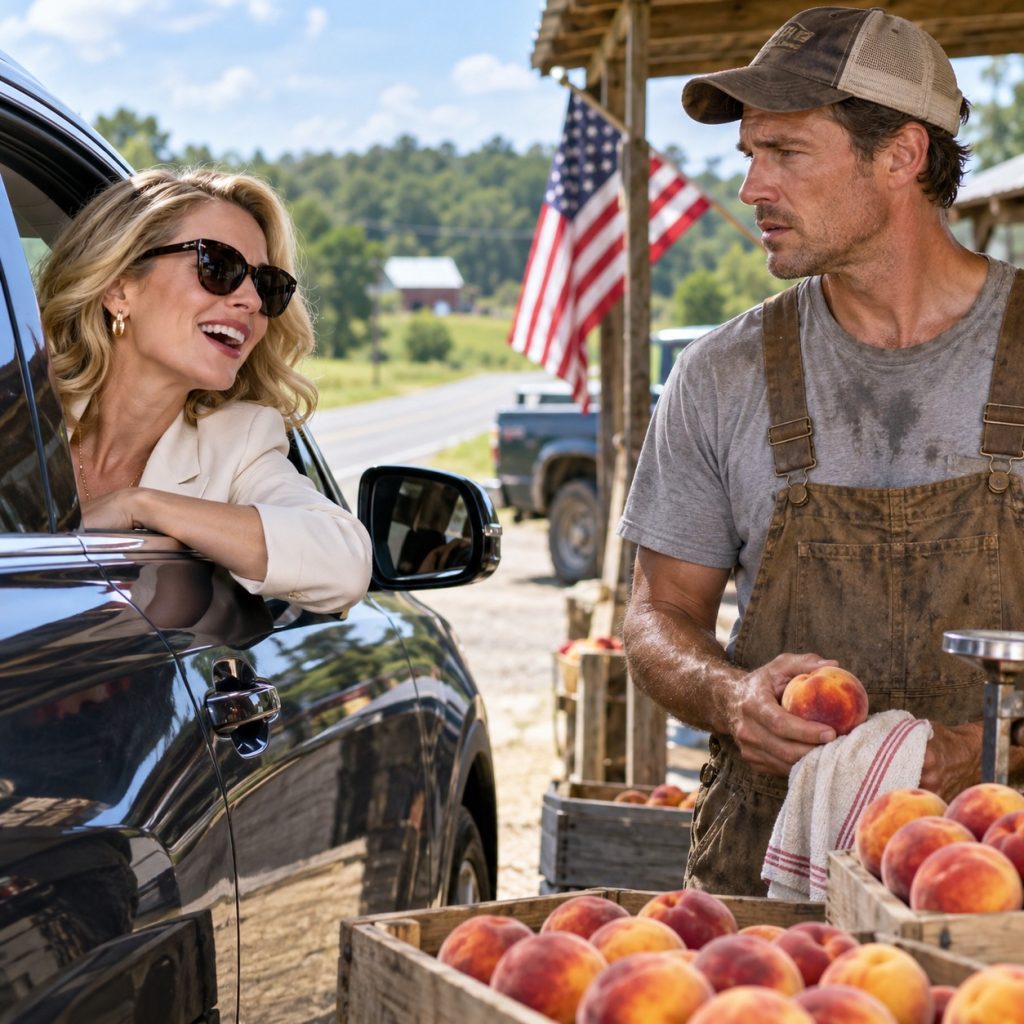
Well, look who it is. My ex-husband still hauling peaches on the side of the road. That’s serious him.
>> 20 years and he still smells like fertilizer. Some people just never leave their lane. >> Kendra, I’m not here for nostalgia.
These orchards, all of them are going into the Greenbridge district. The farmers have already agreed. You’re just standing in the way.
>> Have they? >> They don’t have a choice. >> She signed that paper like it was nothing.
Like the land those families had worked for generations was already hers to hand over. Kendra had pulled into Route 27 that morning expecting to make a point. And she had.
She’d humiliated me in front of her investors, written off an entire community with one sentence and walked away convinced she’d already won. What she didn’t stop to consider was why I hadn’t argued back. Why I’d just watched her sign.

Why a man who supposedly had nothing to lose looked so completely unbothered. What was she actually setting in motion? And who exactly had she just underestimated?
If you’ve ever been written off by someone who didn’t bother to find out who you actually were, stay with this one. Stories like this are what this channel is built for. And if you’re not subscribed yet, now’s a good time.
She drove away laughing, and I just stood there holding a bag of peaches. The dust from her convoy hadn’t even settled yet. Three black SUVs rolling down Route 27 like some kind of motorcade, her investors craning their necks to get one last look at the man with dirt under his fingernails who’d had the nerve to question Kendra Sutton.
I watched the last vehicle disappear around the bend, then turned back to my scale, adjusted the weight marker, and kept working. That’s the thing about Kendra. She always needed an audience.
Even back when we were married, every argument was a performance. She’d pick the moment with the most witnesses, deliver her lines, and leave before anyone could respond. Today was no different.
She’d pulled up to Bellamy Fruit Stand with four investors, a financial adviser and two assistants, made her speech signed whatever paper her adviser handed her, and treated the whole interaction like a press conference. She was gracious enough to hold in my direction.
What she didn’t know, what she’d never bothered to find out after our divorce was that the company I’d built after leaving Brier Glenn wasn’t a small trucking operation anymore. It hadn’t been for a long time. But I wasn’t ready to say that out loud.
Not yet. My father built this stand in the early 1990s from four sheets of pine and a handlettered sign. He’d drive the truck out here before sunrise, set up the display before most people finished their coffee, and spend the day talking to whoever stopped farmers tourists, kids dragging their parents off the highway for a bag of peaches.
He didn’t make much money doing it. That wasn’t really the point. The point, as he explained it to me one afternoon when I was about 12, was that a man should never get so big he forgets where he started.
He said,”A lot of people make money and then spend the rest of their lives pretending they didn’t come from somewhere small.” He didn’t want that for himself. He didn’t want it for me either.
I left Brier Glenn at 22 with a business degree I’d paid for with scholarship money and weekend shifts and two refrigerated trucks. I’d bought secondhand from a produce distributor going out of business in Mon. I had four clients in the first year, eight in the second.
By the time I was 30, Bellamy Meridian Group had distribution contracts across seven southeastern states, and I was negotiating warehouse leases in Ohio and Pennsylvania. I came back to the stand every harvest season. My sister Alana thought it was guilt.
My former colleagues thought it was sentimentality. The truth was simpler than either. I came back because this place kept me honest.
$90 billion in enterprise value is an abstraction. A bag of peaches you picked yourself and sold to a woman driving through on her way to see her grandchildren. That’s real.
That’s the thing you can hold in your hands. Kendra had never understood that distinction. It was one of the reasons we didn’t last.
Walter Gaines found me just afternoon when the lunch crowd had thinned out and I was restacking the display. He’s been farming the same 40 acre peach orchard 2 mi up the road since before I was born. He moves slowly now and he doesn’t talk much, but when he does, he means it.
He handed me an envelope without saying a word first. I read it, then I read it again. Read it.
It was a letter from Stonebrook Agricultural Finance formally worded professionally types set informing Walter that his farm loan account was in a rears and that full repayment was required within 72 hours.
Failure to comply would trigger a contract clause allowing Stonebrook to assume operational rights over the property and its distribution agreements. I looked up at him. His hands were steady, but his jaw was tight.
Walter told me he’d never missed a payment. Not once in four years. He kept every receipt, every bank confirmation, every transfer record.
He’d been paying through an intermediary account that the Greenbridge office had set up for area farmers about 8 months ago. They’d told everyone it would streamline processing, consolidate the payments, make things easier. He hadn’t thought much of it at the time.
It sounded reasonable. That was the detail that stayed with me after he left. Not the letter itself, the intermediary account.
I’d spent 25 years in supply chain logistics. I knew what an intermediary account was for. I knew what it could do if someone on the other end decided to reclassify incoming funds before they hit the final destination.
It wasn’t a sophisticated fraud. It was actually quite simple. Simple enough that most people wouldn’t notice until they received a letter exactly like the one Walter had just shown me.
I told him not to sign anything, not to respond to the letter. I’d look into it. He nodded, tucked the envelope back into his jacket, and walked back to his truck.
He didn’t ask me what I planned to do. Walter isn’t that kind of man. He just trusts that when someone tells him they’ll handle something, they mean it.
I wasn’t going to let that trust become one more thing, Kendra turned into a weapon. The Greenbridge proposal had been circulating for about 6 weeks before Kendra showed up at my stand.
I’d heard about it the way you hear about everything in Brier Glenn through the farmers themselves over coffee at the feed store on Tuesday mornings through my sister who kept the books for the local growers cooperative.
The pitch sounded generous, a 6.8 billion modernization project that would bring cold storage, guaranteed distribution contracts, debt relief, and road improvements to the entire Route 27 corridor.
In exchange, participating farms would transfer operational control of their land contracts and distribution agreements to Greenbridge Renewal Alliance for multiple decades. Most people heard debt relief and guaranteed contracts and stopped reading after that. I didn’t blame them.
When you’ve been fighting drought cycles and fluctuating wholesale prices for 30 years, someone offering to take those problems off your hands sounds like salvation. But I’d read the full proposal document and the language in section 7 was not the language of a development partnership. It was the language of acquisition.
I drove to the county offices that evening and pulled the Greenbridge filing from the Marston County Agricultural Trust records. That’s where I found it buried in the supporting documentation three pages deep in a stack of easement amendments. Bellamy Orchard founding easement voluntarily released.
I sat in the parking lot of the county building for a long time after that. My father had held what’s called a founding easement, a legal instrument granted to the original families who established agricultural use on Brier Glenn land in the late 1960s.
It gave those families a specific right, the ability to block any transfer of collective agricultural control to entities outside the farming community. It wasn’t a property deed.
It wasn’t worth money in any direct sense, but it meant that no outside organization could assume consolidated control over the area’s farming operations without the consent of the founding family representatives. The document I was looking at said that easement had been voluntarily surrendered.
That my father, a man who made me swear on his deathbed that I would protect this community the way he always had, had signed it away. I knew that was a lie before I finished reading the sentence. I’d kept his original certificate in a fireproof lockbox for 18 years.
Mon’nique Harper works out of a small office on the second floor of the agricultural trust building, the kind of office with filing cabinets that actually get used and a coffee maker that’s been running since the Clinton administration. I’d met her twice before briefly at county hearings.
She had a reputation for being thorough and difficult to rush, which is exactly what you want in someone who handles land records. I brought the original founding easement certificate the next morning. I set the document on her desk and asked her to compare it against what Greenbridge had filed.
She didn’t look at me when I came in. She looked at the document that told me something important about Mo’Nique Harper. She wasn’t going to be impressed or intimidated by whatever story I brought her.
She was going to look at the paper. She spent 40 minutes cross-referencing registration numbers, filing dates, and archive records. At one point, she stood up, walked to the third filing cabinet on the left, pulled a folder without hesitating, and sat back down.
She didn’t explain what she was looking for. She just kept working. When she finally looked up, she set down her pen in a particular way, deliberately, like she was making sure her hands were free before she spoke.
She told me the registration numbers didn’t match. The document Greenbridge had submitted bore a filing date that didn’t correspond to any amendment in the original easement record.
The signature on the Greenbridge version had been authenticated by a notary whose license number wasn’t on file with the state for the year indicated and the original easement as certified by the trust’s own records had never been amended, transferred or surrendered. The Bellamy founding easement was still active.
The information Greenbridge had submitted to the trust was inaccurate. The project could not be certified for approval until the discrepancy was resolved. I thanked her and stood to leave.
She said one more thing before I reached the door. She told me she’d been in this office for 11 years and had watched a number of development proposals move through Marston County. The ones that arrived with this much paperwork filed in this short a window were always worth examining carefully.
Her father had lost farmland in a deal structured very similarly to this one, and she’d chosen this line of work partly because of what that loss had done to her family. She wasn’t going to let a filing discrepancy stand unchallenged if someone’s land was at risk. She said it plainly, not for effect, just so I’d know where she stood.
I walked out into the morning with two things I hadn’t had the day before, a legal basis to halt the Greenbridge approval process, and the name of someone I could trust to follow the paper where it led. I had a decision to make, and I knew it.
The straightforward move was to call my legal team surface the Bellamy Meridian connection publicly, and let the financial weight of a 90 billion enterprise, make clear to everyone involved that Greenbridge was picking a fight it couldn’t survive. Kendra would have her project dismantled before the week was out.
The farmers would be safe and I could go back to running my company from a conference room in Atlanta. That option was clean. It was efficient and it would have solved exactly nothing.
Because here’s what I’d learned in 25 years of building something from nothing. Power that comes from somewhere else isn’t really yours.
If I swept in and protected Brier Glenn by making it clear that a billionaire had their back, I’d be doing exactly what Kendra was doing, just with a friendlier face on it, the farmers would owe me their safety instead of owing her their land. Different collar, same leash. So, I chose the harder thing.
I decided to stay quiet about Bellamy Meridian and let the evidence do what evidence is supposed to do, speak for itself. What I didn’t fully appreciate yet was the cost of that choice. I’d spent my entire year deciding what information to share and when to share it.
What it had also made me something I hadn’t wanted to look at directly was the kind of person who was always standing slightly outside the circle, managing the situation, controlling the narrative, never fully letting anyone in. Alana had been trying to tell me that for years.
I found her at the cooperative office late that afternoon, a converted storage room behind the feed store that she’d turned into a functional accounting workspace with nothing but good organization and stubbornness. She was at her desk when I came in, and she didn’t look surprised to see me.
My sister is 10 years younger than me, and she has our father’s eyes and our mother’s patience, which means she has a great deal of patience right up until she doesn’t, and then she says exactly what she means without raising her voice. She asked me what I thought I was doing showing up at Brier Glenn now. I told her I was trying to help.
She looked at me for a long moment with the particular expression she reserves for things she finds both true and insufficient.
She said she’d been helping for the past 20 years through the Anderson family’s drought crisis, through the reszoning fight in 2019, through every bad season and every meeting where someone knew showed up with a plan that ended up benefiting everyone except the people who actually farmed the land. She wasn’t wrong. I knew she wasn’t wrong.
She asked me what I knew about Stonebrook and whether I was planning to tell her all of it or just the parts I decided she needed. That landed harder than anything Kendra had said all day. I told her about Walter’s letter.
I told her about the intermediary account and what I suspected was happening with the payment records. I told her about Mo’Nique’s findings and what the easement situation meant for the Greenbridge timeline. What I didn’t tell her was Bellamy Meridian.
I told myself it was because a restructuring deal required confidentiality. I told myself the timing wasn’t right. I told myself a lot of things that were technically accurate and fundamentally evasive.
She listened to everything, asked two precise questions about the Stonebrook account structure and told me she was going to pull Walter’s full payment history herself. Before I left, she said one thing that stayed with me. She told me that what I was doing, deciding what people were allowed to know, wasn’t protection.
It was the same thing Kendra was doing, just quieter. I left without finding an answer to that. Outside, the evening was settling over Route 27 in the way it does in late summer.
The light going orange through the peach trees, the air still carrying heat, but losing the edge of it. I stood beside my truck and looked at the stand. The pine boards my father had cut himself.
The scale that still worked. The handlettered price list I’d repainted every few years to keep it legible. She was right that I hadn’t been here.
I’d sent money. I’d made calls. I’d arranged things from a distance the way I arranged everything efficiently, cleanly without taking up too much space in anyone’s actual life.
That had felt like consideration. Now, I wasn’t sure it hadn’t just been another form of control. Mon’nique’s finding bought us two days before Kendra found her footing again.
The Agricultural Trust issued a formal hold on the Greenbridge certification standard procedure when supporting documentation contains unresolved discrepancies. For about 48 hours, the mood in Brier Glenn shifted. Farmers who’d been quietly dreading the Greenbridge timeline started breathing again.
Walter stopped by the stand on Thursday morning, shook my hand with both of his, and didn’t say much. He didn’t need to. The hold was real, and for the first time in weeks, so was the possibility that things might not go the way Kendra had planned.
I should have known better than to read that as progress. Kendra didn’t respond to legal setbacks the way most people did with lawyers and counter filings and the slow machinery of formal dispute. She responded with narrative.
When something threatened her position, she didn’t defend it directly. She reframed it, repackaged it, and handed it back to the room in a shape that made her look like the reasonable one. By Friday afternoon, she’d called a community meeting at the agricultural hall.
And by Saturday morning, the story circulating through Brier Glenn wasn’t about a flawed easement filing. It was about me. The version Kendra was telling went like this.
A man who’d abandoned his hometown for 20 years had suddenly reappeared the moment a major development deal was about to close. He’d dug up an old piece of paperwork from his deceased father’s estate to throw a legal wrench into a project that would benefit hundreds of local families.
And now, rather than explaining himself, he was going doortodoor asking farmers about their debts, their contracts, and the details of their financial arrangements. Every one of those facts was technically accurate. That was what made it effective.
The first person who pulled back was Dale Hutchkins, whose family had been growing apples on the north end of Route 27 for three generations. He’d been friendly when I first approached him about the Stonebrook Payments had even offered to pull his own records when I explained what I was looking for. By Saturday, he wouldn’t return my calls.
By Sunday, his wife told me through the screen door that they decided to let the process play out on its own. I understood. Dale wasn’t a coward.
He was a man with a mortgage and two grandchildren and a farm that represented everything his family had built. Kendra had given him a story that made caution feel like wisdom and he’d taken it. I couldn’t be angry about that.
I just had to work around it. What I kept coming back to was the intermediary account. Everything else, the easement filing, the certification hold the public relations battle was noise by comparison.
The real mechanism was simpler and more ruthless than most people would expect. Stonebrook Agricultural Finance had been receiving payments from farmers through a Greenbridge recommended processing account for the better part of 8 months. The money was arriving.
It was clearing. And somewhere between arrival and final posting, someone was reclassifying it, recording it not as a completed payment, but as a pending or failed transaction, leaving the loan account in a state of apparent default, while the actual funds sat in an intermediate ledger doing something else entirely. It wasn’t new.
I’d seen variations of this in commercial supply chain fraud, usually smaller scale, usually caught faster. The reason it worked here was that the farmers trusted the system because Greenbridge had set it up and nobody audits an account they think is working. Alana had started pulling records the night I left her office.
I knew because she called me at 6:15 in the morning 3 days later and Alana doesn’t call before 8 unless something is wrong or something is right enough to not wait. She told me to come to the cooperative office. When I got there, she had Walter’s full payment history spread across her desk.
not just the summary statements, but the raw transaction records she’d requested directly from the cooperative’s shared banking interface.
She’d also pulled three other farmers records through the same system because four of the area growers had consolidated their financial management through the cooperatives shared accounts after Greenbridge recommended the intermediary setup. She pointed at the screen without looking at me first.
The pattern was exactly what I’d suspected, but seeing it laid out in columns made it something different than a theory. Every payment had arrived at the intermediary account on time. Every payment had been acknowledged with an automated confirmation.
And then between 48 and 72 hours after receipt, each transaction had been reclassified under a different account code, one that flagged the payment as a processing exception, which in Stonebrook’s system generated an automatic delinquency notice to the borrower while the funds continued to sit in the intermediary account unposted.
Alana told me she’d found the same pattern across all four accounts she’d checked. different farmers, different loan balances, different payment schedules, same reclassification, same timing window, same outcome. She said it quietly, the way she said things, she’d figured out that she wished she hadn’t needed to.
Then she said something I hadn’t expected. She said she’d been the administrative contact for a portion of the cooperative’s shared financial interface during the period in question, and that the Greenbridge intermediary account had been visible to her as an authorized contact. She hadn’t looked at it closely because she’d had no reason to.
That was going to be a problem, she said, if this went public. People would ask why the cooperative’s own bookkeeper hadn’t caught it sooner. I told her that wasn’t her fault.
The system was designed to look normal. That was the entire point. She said she knew that.
She also said knowing something and being able to explain it to a room full of people who’d already decided you should have caught it were two very different things. The community meeting Kendra had called was on Tuesday evening, and I went because not going would have made everything she was saying about me easier to believe.
The agricultural hall holds about 200 people comfortably. That night, it held closer to 260 with the overflow standing along the back wall and both side exits propped open. Kendra was at the front of the room.
She was good at this composed, reasonable sounding with the particular energy of someone who’s already won the argument in her own mind and is just being patient while the room catches up.
She walked through the Greenbridge proposal again, hit the same points about cold storage and debt relief and guaranteed markets and then almost as an aside almost gently brought up the certification hold and what had caused it. She called it a paperwork discrepancy from decades old filing records.
said her team was working with the trust to resolve it efficiently and delivered it with the kind of calm that implies the person raising the issue is making trouble over nothing. Then she looked at me. She asked in front of everyone why I’d been visiting farms and requesting access to private financial records.
She asked whose interests I was actually representing. She said that any responsible investor or operator would disclose their financial stake in a situation before going doortodoor asking about other people’s debts. The question wasn’t really a question.
It was a trap framed as transparency. I answered it the only way I could without disclosing Bellamy Meridian before I was ready. I told her I was representing myself.
She smiled and said that was exactly what concerned her, that a private individual with undisclosed interests had been conducting what amounted to a financial investigation into the personal loan records of local farming families. And that those families deserve to know why. The room shifted.
I could feel it. Not a dramatic turn, more like a collective adjustment. The way people move when something they decided to believe suddenly requires a little more effort to hold on to.
Walter was in the third row. His expression hadn’t changed to hostility. He wasn’t that kind of man.
But there was something careful in it now. Something that hadn’t been there when he shook my hand at the stand. Alana was standing against the far wall.
When my eyes found hers, she looked away first. Not dismissively, more like she was working something out and didn’t want me to see the process. I stood up and addressed the room directly.
I told them what I’d found. the payment records, the reclassification pattern, the fact that every farmer who’d received a default notice had actually made their payments on time.
I said I was working to get independent verification of what Alana had found in the cooperative’s records and that the Stonebrook situation needed a full audit before anyone signed anything new. Kendra, let me finish.
Then she said that if I had legitimate evidence of financial irregularities, I should bring it to the appropriate regulatory authorities rather than to a community meeting. She said that making accusations in a public forum without filing a formal complaint or disclosing my own financial position was not transparency. It was theater.
She said it without malice. That was the most effective part. I left the meeting knowing I’d lost the room.
Not completely and not permanently, but enough. Alana caught up with me in the parking lot. She walked beside me for half a block before she said anything, and what she said wasn’t what I’d expected.
She didn’t defend me or criticize Kendra. She asked me directly what I wasn’t telling them.
She said she’d been doing the math, the connections I’d made, the speed with which I’d understood the Stonebrook mechanism, the fact that I seemed to have resources and relationships that didn’t match the profile of a man who occasionally sold fruit by the road. She said she wasn’t asking me to confirm or deny anything specific.
She was asking whether there was something she needed to know in order to do her job correctly because she was about to put her own professional credibility behind the payment records she’d found and she wanted to know what she was standing next to when she did.
I stood there in the parking lot and thought about the restructuring deal, about the confidentiality obligations, about the emails from three lawyers telling me that any public disclosure of Bellamy Meridian’s operational structure during the current negotiation window could cost the company billions of dollars in deal value.
I thought about all of that and then I told my sister I couldn’t explain everything right now, but that I would, that I needed a little more time and was asking her to trust me. The look she gave me then is one I’ll carry for a long time. Not anger something older and quieter than anger.
The expression of someone who has been given a version of this answer before by the same person in different circumstances and has learned not to be surprised by it anymore. She said she’d present the payment records.
She’d stand behind what she’d found because what she’d found was true and she wasn’t going to let the truth sit on a desk because things were complicated. But she said the gap between what I knew and what I was telling her wasn’t protection. It was the same thing Kendra was doing, just quieter.
She walked back to her car. The 48 hours after that meeting were the worst of the entire situation. The certification hold was still in place, but Kendra’s legal team had filed a motion to have it reviewed on an expedited timeline, arguing that the discrepancy was a clerical matter that shouldn’t delay a project serving clear public benefit.
Mon’nique was holding firm, but the motion put pressure on the trust’s administrative process in ways that were going to take time to resolve. Stonebrook had not backed down on the default notices. 47 farming families were now sitting with letters demanding full repayment on timelines ranging between 72 hours and 10 days.
The rumor that I was planning to acquire distressed properties myself had taken hold in the way that rumors do when they’re planted by someone who knows exactly which soil they’ll grow fastest in. And Alana had gone quiet. Not hostile.
She was still pulling records and doing the work. But the tentative thaw between us had closed again. I’d done that.
I knew I’d done that. I drove to the stand after midnight and sat on the tailgate looking at the orchard across the road.
I thought about something I’d told one of Bellamy Meridian’s regional managers about 5 years ago when he tried to handle a supplier dispute by controlling the flow of information to every party involved, feeding each side just enough to keep them cooperative without letting anyone see the full picture. It had worked technically.
The dispute was resolved and 6 months later, every supplier in that region had quietly begun moving their contracts to competitors because they’d figured out they’d been managed rather than dealt with honestly.
I’d told that manager the problem with controlling information is that when people eventually find out what you were holding back, and they always find out, they don’t just lose trust in the specific thing you hid, they lose trust in everything you’ve ever told them. I’d said that to someone else about someone else’s mistake.
It had taken me this long to understand I’d been making the same one. The question that had been forming for the past week finally came into focus clearly enough to look at directly. I’d been asking how to beat Kendra.
That was the wrong question. The right question was how to make sure that after all of this was over, this community would never need me to beat anyone for them again. That was the thing that needed building.
And it was going to require me to stop deciding what everyone else was allowed to know. The next morning, I started over. Not with lawyers, not with a press release, not with any of the tools I’d been holding in reserve.
I started the way my father would have by showing up at people’s doors and asking one question. Not about Stonebrook or Greenbridge or anything that required them to trust my version of events. Just what do you actually need in order to survive on your own terms?
Some farmers were guarded when they saw me coming. A few turned me away at the door. I didn’t push.
I left my number with whoever would take it and moved on. What I was listening for wasn’t grievances. It was specifics.
The actual structural problems that made these farms vulnerable to a pitch like Green Bridges in the first place. By the third day, the picture was clearer than any financial analysis I could have commissioned. These families didn’t need a billionaire.
They needed a cold storage facility within 30 mi that didn’t charge extractive access fees. They needed a buyer who would commit to a minimum volume purchase more than one season in advance. They needed loan terms that didn’t evaporate the moment a payment got misouted through someone else’s accounting system.
They needed the right to set their own prices instead of accepting whatever the distributor offered the week of harvest. Those weren’t revolutionary demands. They were the basic conditions of running a viable small farm.
and Bellamy Meridian had been solving exactly those problems for regional growers in 11 other states for the past 15 years. I’d been so focused on protecting this community from Kendra that I hadn’t stopped to notice I was already holding everything they needed. I just hadn’t offered it honestly.
I spent two days drafting the cooperative structure with my legal team over the phone, working through the specifics of what a genuine partnership, not an acquisition dressed up as one, would actually require. The legal team was not enthusiastic.
The restructuring deal they’d been managing for 11 months was at a sensitive stage, and publicly connecting Bellamy Meridian to a rural Georgia land dispute in the middle of that process was exactly the kind of noise they’d spent nearly a year trying to avoid. I told them to draft the documents anyway. I knew what it would cost.
The disclosure would almost certainly unwind a significant portion of the deal value we’d spent months structuring, and the legal team’s estimate of the potential loss ran into the billions. I’d made peace with that number somewhere between midnight and sunrise on the stand’s tailgate.
Some things are worth more than what they cost, and you don’t always know which things until you’re standing in front of the choice. The structure I was proposing was straightforward in intent, though the legal architecture took some work.
Bellamy Meridian would commit to purchasing a guaranteed minimum volume of produce from participating Brier Glenn Farms for 12 consecutive years. A contract substantial enough to serve as collateral for refinancing the Stonebrook loans but structured so that the farms remained independent operators, not Bellamy suppliers.
A separate capitalized with my own funds, but governed by an independent board would refinance the fraudulent defaults at fair terms with the explicit legal condition that I could not withdraw those funds unilaterally or restructure them without majority approval from the farming families themselves.
Bellamy Meridian would have no ownership stake in any cooperative land. I would hold no seat on the governance board. Every significant decision would require a vote from the farmers who actually worked the properties.
The simplest way to describe it. I was building a structure designed to make itself independent of me as quickly as possible. If I disappeared tomorrow, the cooperative would continue.
The purchase contracts would hold. The trust would keep operating. My involvement was the scaffolding, not the building.
The only thing that made all of it real, legally binding, bankable, worth the paper it was drafted on was a public declaration of who was actually behind it. There was no version of this that didn’t require saying the name Bellamy Meridian out loud in front of everyone and accepting whatever came next.
Walter came to me the night before the final community meeting. Not in the morning, not at the stand. He came to the place I was staying, a rented room above the hardware store on Clement Street.
He knocked at a little past 9 in the evening and stood in the doorway with his hat in his hands, which is how Walter signals that he’s about to say something that cost him something to decide to say.
He told me he’d been asking around, not about me specifically, about Stonebrook, about the intermediary account, about the payment records Alana had been quietly sharing with the farmers she trusted most. He said three different people had confirmed the same basic pattern.
money going in, money getting lost in the reclassification default notices appearing like clockwork regardless. He’d pulled his own bank statements and laid them side by side with the Stonebrook delinquency record. And the math didn’t add up in a way that could be explained by accident.
Then he said something I hadn’t expected from a man who normally rationed words like they cost him personally.
He said he didn’t fully understand what I was or what I was trying to build, but that he’d been farming this land for 40 years and had developed a reliable instinct for who was trying to take something and who was trying to leave something behind. He said I felt like the second kind even when I was being difficult about it.
He put his hat back on and said he’d be at the meeting tomorrow. After he left, I sat at the small table by the window for a long time. The thing about Walter’s was that it wasn’t easy trust.
It wasn’t the kind that gets handed out because someone made a good impression or said the right things at the right moment. It was the kind that had been withdrawn and carefully reconsidered. The kind that means something precisely because of everything it had been through to get back here.
The Brier Glenn Agricultural Hall on a Tuesday evening in late summer holds a particular quality of light, the kind that comes through old windows at an angle and makes everything look like it’s being examined. The room was full again, maybe fuller than the last meeting because word had gotten out that something definitive was going to happen.
Kendra was already at the front when I arrived.
She’d updated her presentation with new slides that addressed the payment record allegations, a clean graphic showing Stone Brook’s loan servicing process, a note that any discrepancies were under internal review quotes from two farmers who’d stayed publicly supportive of Greenbridge, and a timeline showing how quickly the district could be
operational once the certification hold was resolved.
She was composed and completely prepared, which meant she’d expected this meeting to be the one where she closed it. She led with the photograph. It appeared on the projection screen behind her, me at the stand in a worn work shirt weighing peaches into paper bags.
She let it sit for a moment before saying anything, letting the visual do its work. Then she introduced it as a picture of the man who was asking Brier Glenn to reject a $6.8 billion investment and said it with the particular tone of someone offering the room permission to find something absurd.
I walked to the front and presented the cooperative proposal, all of it clearly and without abbreviation, the 12-year purchase commitment, the independent trust, the governance structure, the fact that I would hold no ownership stake and no vote.
I explained what the refinancing would do for the Stonebrook situation and how the trust’s legal structure prevented anyone, including me, from unwinding it unilaterally. Kendra waited until I finished. Then she asked who was behind the money.
I told her Bellamy Meridian Group. She smiled the same smile she’d used years ago when she thought she had me cornered and said that confirmed everything she’d been trying to tell the room. I was a representative of a large corporate interest, she said, who’d been conducting himself as a private individual.
She said,”So you work for them?” I said,”No.” The room went quiet.
I said,”I founded Bellamy Meridian.” I said,”I still hold the controlling interest.” I said,”The enterprise value of the company is approximately $90 billion.”
And I said it the way you state any fact without drama because drama would have made it sound like something other than what it was, which was the truth I should have led with a week ago. A the silence that followed was a different kind of silence, not confusion, the silence of a calculation happening simultaneously in 200 different minds.
Kendra’s composure didn’t break visibly, but something in her expression reset the way a screen resets when it’s processing something it wasn’t built to handle.
The man she’d photographed selling peaches by the road, the man she’d called a nostalgic failure in front of her investors, the man she’d spent the last week repositioning as a corporate interloper, was the founder and controlling shareholder of a company worth more than 30 times the entire Greenbridge project. She recovered faster than I expected.
She told the room that the revelation only made her point more clearly. I’d stood in front of these families for days and allowed them to believe I was something I wasn’t. And if I was willing to conceal something this significant, the cooperative I was proposing deserved intense scrutiny.
It was a good pivot. I’d underestimated her ability to absorb a blow and find the angle in it. I didn’t answer her directly.
I turned to face the room and told them she was raising a fair point. I said I had made a deliberate choice to withhold information and that I told myself it was for good reasons and that some of those reasons were even true.
But the effect was the same regardless of the intent these families had been making decisions without the full picture and I was partly responsible for that. I said I was sorry for that specifically not as a rhetorical move but because it was accurate and they were owed it.
I set the cooperative documents on the table at the front of the room and told them that every term was in writing, that independent council had reviewed the structure, and that the decision about whether to participate was entirely theirs. I would not campaign for it. The table was there.
The terms were there. What they did with it was theirs to decide. The moment I sat down, Alana stood up.
She’d been near the back wall, the same place she’d stood at the previous meeting. She had a manila folder in her hand, the kind that contains things someone spent a long time making sure were correct before bringing them anywhere public.
She introduced herself as the cooperative’s financial administrator and said she had documentation she wanted to present regarding the Stonebrook payment records. She said she was doing this as an individual acting on what she’d found, not as a representative of any party in the room.
Then she walked through it not quickly, not with drama, but with the precise and methodical delivery of someone who has done the work and trusts the work to carry itself. She showed the payment records. She showed the transaction timestamps.
She showed the reclassification codes and the timing window 48 to 72 hours after receipt during which each payment had been converted from a completed transaction to a processing exception.
She showed it for Walter’s account, then for three others, then stated plainly that she had preliminary records suggesting the same pattern across the majority of Stone Brook Serviced accounts in the Greenbridge system.
She also said, without being asked, that she had been the administrative contact for a portion of the cooperatives shared financial interface during the period in question and that the intermediary account had been visible to her. She hadn’t looked at it closely because she’d had no reason to.
She said that directly without qualification in a room full of people, some of whom would use it against her professional reputation. She said it a because the truth of what she’d found required the truth of what she’d missed to mean anything. That took more courage than anything else that happened in that room.
Monnique Harper confirmed from her seat that the Agricultural Trust had already received a preliminary audit report that morning filed by an independent auditor whose findings were structured to be released to the trust rather than to me personally and that the findings aligned with what Alana had presented.
The trust was formally referring the Stonebrook account structure to state financial regulators for review. Kendra attempted one more repositioning.
She said that even if the Stonebrook situation represented a procedural failure, it had no bearing on the fundamental merit of the Greenbridge project, which had been developed independently and offered genuine value to the community. She said her organization should not be held responsible for the practices of a third-party financial serviceser.
The room let her finish. And then Walter Gaines from the third row asked one question in the direction of no one in particular. He asked why Greenbridge had specifically recommended that the farmers use Stonebrook’s intermediary system in the first place.
Nobody answered. Nobody needed to. Kendra’s board suspended her involvement in the Brier Glenn project before midnight.
Stone Brook’s accounts were frozen pending regulatory review. The default notices, all 47 of them, were formally stayed. 3 months later, the Brier Glenn Growers Cooperative held its first official board meeting in the agricultural hall.
the same room, different energy entirely. Walter Gaines was elected chairman by a vote that wasn’t close. He gave a short speech which was appropriate for a man who treated words like a limited resource.
He said his family had farmed peaches on Route 27 for four decades, and he intended to farm them for four more, and that he was glad to be doing it on terms he’d chosen himself. The room applauded, which seemed to embarrass him, which was exactly right for Walter. Alana took the financial administrator role with the cooperative formally.
Her first act in the role was to implement a payment verification protocol that would make the kind of reclassification Stonebrook had run structurally impossible going forward. She was methodical and exact, and she trusted the numbers more than she trusted anyone’s word, including mine. Those were the right instincts for the job.
Bellamy Meridian was the cooperative’s largest customer, not its owner. The distinction matters, and I made sure it was in writing in more than one place. I kept my word.
No land, no veto, no chairman’s seat. The restructuring deal my legal team had spent 11 months building did take a significant hit from the disclosure, exactly as they’d predicted. The final cost landed somewhere in the range of several billion dollars in deal value.
I’d known that going in. I’d signed anyway. There are things you can rebuild and things you can’t, and I’d spent enough time in enough boardrooms to know the difference.
At the first board meeting, I sat in the back row. The farmers debated a scheduling question about the cold storage access calendar, a pricing dispute with a secondary distributor, and a proposed amendment to the membership criteria for new applicants. None of it required me.
I was there because I wanted to be, not because anyone needed me to be me. After the meeting, Alana found me in the parking lot. We walked to her car and she said she still hadn’t forgiven me for the years I was gone.
She said it matterof factly not with heat because it was simply true and she saw no reason to dress it up. I told her I wasn’t asking her to forget. I told her I was asking for the chance to be present in a way I hadn’t been and that I understood I’d have to earn what that meant over time rather than announce it and expect it to be accepted.
She unlocked her car and got in. Before she closed the door, she said she’d be at the stand on Saturday if I was planning to open it. She said she’d bring coffee.
It wasn’t forgiveness, but it was a door opened a few inches, and I knew better than to walk through it before I’d been invited. That Saturday, I drove to the stand before sunrise the way my father always had. I set out the day, calibrated the scale, wrote the prices on the board in the same lettering I’d been using for years.
Alana arrived a little after 7 with two cups of coffee and we stood behind the counter in the early morning quiet and watched the road the way our father used to waiting for whoever came next. A car pulled over around 7:30.
The driver recognized me from the news coverage and sat with the information for a moment before asking if I was actually who he thought I was. I told him yes. He looked at the stand the way people look at things that don’t fit the category they’re supposed to fit in.
Then he asked why someone with a $90 billion company was out here selling peaches on the side of a county road. I handed him his bag and told him the truth. The company told me how far I’d traveled.
The stand reminded me where I started. Both things mattered and I’d spent too many years treating them like they couldn’t coexist. He paid nodded slowly the way people do when something is simpler than they expected and drove away.
No security, no entourage, no title on a lanyard. Just the stand and the scale and the work and my sister standing next to me with her coffee going cold because she kept forgetting to drink it while she was watching the road. That’s the thing nobody tells you about building something real.
It’s not the money that reveals your character. It’s what you do with the power the money gives you. Whether you use it to pull people closer to independence or to pull them closer to you.
Kendra wanted to develop Brier Glenn. So did I in my own quieter way for longer than I’d admitted to myself. The difference in the end wasn’t in the resources we brought to the table.
It was in the question we were each trying to answer. She was asking how to control the outcome. I had to learn later than I should have to ask how to make the outcome belong to the people who’d earned it.
Walter Gaines is farming his orchard on his own terms. Alana is keeping books that nobody can tamper with. 47 families still have their land.
And every harvest season, I come back to the stand. Not because I have to, because this is where I started, and I’ve decided that’s not something to move past. It’s something to come back to.
If this story stayed with you, there’s more where it came from. Subscribe so you don’t miss the next one. Every story on this channel is about people who were underestimated, written off, or pushed to the edge, and what happened when they finally showed the world who they really were.
We’ll see you in the next one.
