
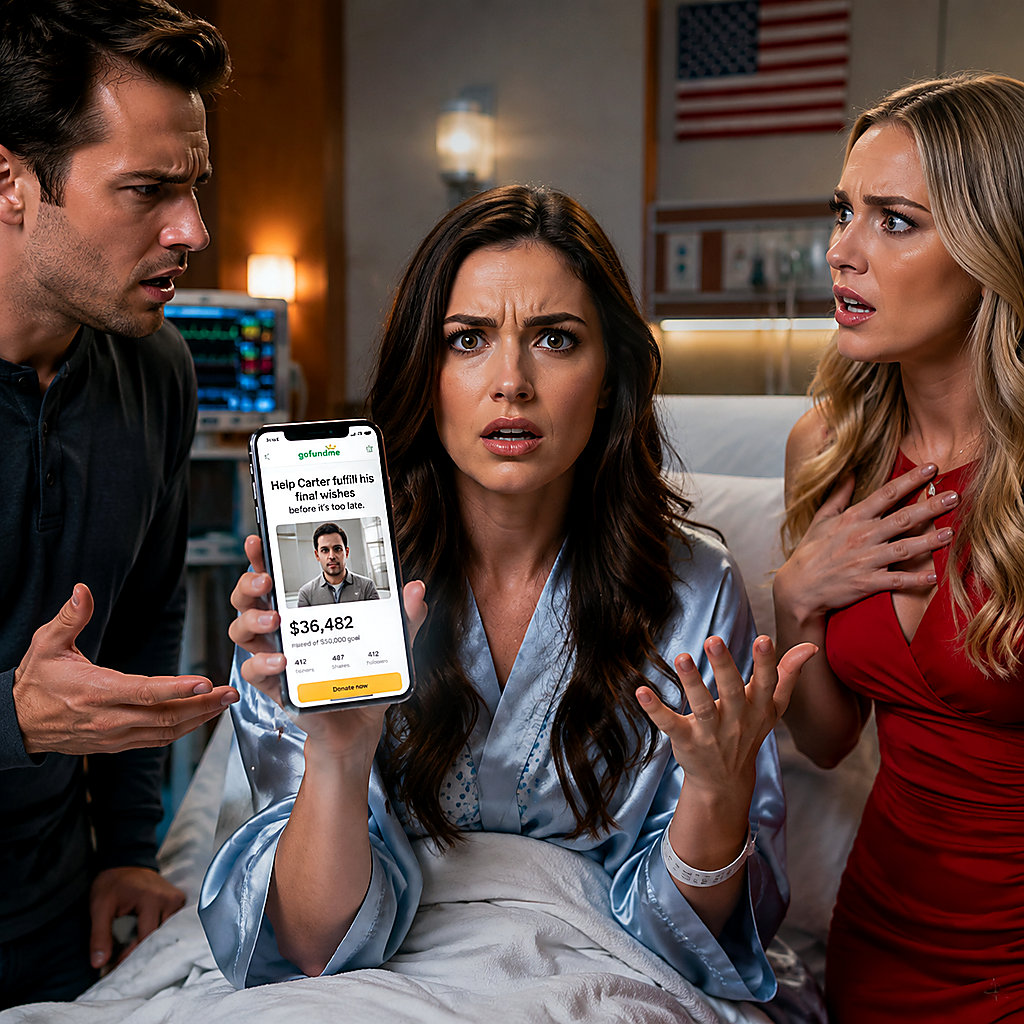
After being diagnosed with a genetic condition, I learned my fiance started a GoFundMe claiming I was terminally ill and needed help with final wishes. She’d raised $36,000 for a wedding before he dies while telling me nothing. I found out when my cousin sent condolences.
I contacted GoFundMe with medical proof, had the campaign shut down, and posted the truth online. She’s now being investigated for fraud and has called my hospital room 78 times. My life has turned into a Lifetime movie crossed with an episode of American Greed, and I’m still trying to process everything that’s happened in the last two weeks.
I’m 29, work as an environmental engineer, and until recently was engaged to Grace, 28. We met 3 years ago through a mutual friend, moved in together last year, and got engaged on New Year’s Eve. Everything seemed perfect, or at least normal couple perfect, with occasional disagreements about dishes, and what to watch on Netflix.
About a month ago, I started experiencing some strange symptoms. Muscle weakness, tremors, difficulty coordinating movements. It got bad enough that I finally went to see a neurologist.
After several appointments, MRI, and genetic testing, I was diagnosed with Huntington’s disease. For those who don’t know, Huntington’s is a progressive genetic disorder that causes the breakdown of nerve cells in the brain. It’s inherited and if your parent has it, you have a 50% chance of getting it, too.
My father died when I was young and my mother never talked much about his health problems, so I had no idea this was lurking in my DNA. The diagnosis hit me hard. Huntington’s is serious.
It causes physical and cognitive decline over time. But, and this is the critical part that my fiance apparently missed. I’m in the very early stages.
My neurologist estimates I have 15 to 20 years of relatively normal life ahead of me before symptoms become severe. It’s not a death sentence next week. It’s a long-term health challenge that thousands of people manage while living fulfilling lives.
Grace was with me when I got the diagnosis. She seemed supportive, if a bit quiet. She asked a few questions about treatment options and life expectancy.
Took some notes on her phone and held my hand as we left the hospital. The next few days were a blur of follow-up appointments, medication discussions, and me trying to wrap my head around this new reality. During this time, Grace was constantly on her phone, which I assumed was her researching Huntington’s or maybe connecting with support groups.
I was focused on my health, not on monitoring her online activities. Big mistake. 10 days after my diagnosis, I got a text from my cousin Ellie that changed everything.
It was a screenshot of a GoFundMe page with my photo and the headline,”Help Carter fulfill his final wishes before it’s too late.” The accompanying message from Ellie said,”Is this real? Why didn’t you tell us things were this bad?
We’re all devastated.” I was confused.”Final wishes? What was she talking about?
Then I looked closer at the screenshot. The GoFundMe had been created by Grace. According to her tearjerking description, I had been diagnosed with terminal brain deterioration and had less than a year to live.
She went on to explain that my final wish was to marry my soulmate and take a dream honeymoon to Japan before I succumbed to this devastating illness. The campaign goal was $50,000. It had already raised $36,482 from 412 donors.
I felt like I’d been punched in the stomach. There was my face, my name, my diagnosis, completely misrepresented, being used to solicit money from strangers, and Grace had told me nothing about it. I immediately called her.
She didn’t answer. I texted her the screenshot with a single question mark. No response.
I checked her location on our shared app. She was at her friend Megan’s apartment. While trying to decide what to do next, more messages started coming in from family members and distant friends offering condolences and asking why I hadn’t told them.
Apparently, Grace had shared the GoFundMe in several private Facebook groups where we had mutual connections, but had somehow managed to exclude anyone who regularly saw me in person. I spent the next hour systematically going through her social media accounts. Yes, I knew her passwords.
We had an open phone policy. The rabbit hole went deeper than I imagined. She had created a whole narrative around my terminal illness, complete with sad updates about my deteriorating condition and how she was being strong for Carter during his final months.
The most disturbing part, she’d been actively discouraging people from contacting me directly, saying I was too weak for visitors and finding it difficult to respond to messages as my condition worsens. She’d effectively isolated me from support while painting herself as the devoted caregiver to a dying man. I was furious and hurt and confused.
This wasn’t some small lie or misunderstanding. This was elaborate calculated exploitation of my genuine health condition. The next morning, I took action.
First, I contacted GoFundMe with evidence of the fraud. my medical records showing my actual diagnosis and prognosis, my ID confirming my identity, and screenshots of Grace’s fabrications. To their credit, they responded quickly and froze the campaign pending investigation.
Then I made a post on my own Facebook page explaining everything. My actual diagnosis, serious but not terminal, Grace’s fraudulent campaign, and my complete shock at discovering it. I asked people to share the post to reach anyone who might have donated based on her lies.
Finally, I called my parents. This was the hardest part. They hadn’t even known I was sick, as I’d been waiting to process the diagnosis myself before telling them.
Now, I had to explain both my Huntington’s diagnosis and my fiance’s betrayal in the same conversation. not my finest hour breaking down on the phone as my mother tried to process that her son had a genetic disease he’d likely inherited from his late father. By that evening, all hell had broken loose.
Grace finally called hysterical. According to her, she’d created the campaign out of love because she wanted to make my last days special. When I pointed out that I wasn’t having last days anytime soon, she switched tactics, claiming she’d misunderstood the diagnosis due to the stress of the situation.
I didn’t buy it. The neurologist had been crystal clear. I’d even had a follow-up appointment with a Huntington specialist who had walked us through the likely progression of the disease, emphasizing that I had many good years ahead.
Grace had asked specific questions about timeline. She knew exactly what my prognosis was. The truth came out when I pressed her.
She’d seen an opportunity and taken it. In her words, she thought we deserved something good to come from this awful situation. The money would help us build memories before things got bad.
She insisted she’d plan to tell me about the campaign once she’d raised enough for the surprise wedding and honeymoon. I ended the call and blocked her number. Then I contacted a locksmith to change the locks on my apartment.
Thankfully, I’d kept my name as the only one on the lease despite her moving in. I messaged her sister to arrange a time for Grace to collect her things while I was out of the apartment. The next day, GoFundMe confirmed they were shutting down the campaign and refunding all donations.
They also informed me they would be reporting the fraud to local authorities as this violated several laws. I hadn’t considered the legal implications, but apparently medical fundraising fraud is taken quite seriously.
That afternoon, I started feeling shaky and weak, a combination of stress and my condition, and decided to check myself into the hospital for monitoring. My doctor had warned that emotional stress could temporarily worsen symptoms, and I was definitely experiencing that.
This is where I am now, in a hospital room, writing this post on my phone, trying to make sense of everything. Grace has called the hospital room 78 times in the past 36 hours. I know because the nurse has been keeping count, initially answering, but now screening all calls.
Apparently, Grace alternates between sobbing apologies and angry accusations that I’ve ruined her reputation. The police came by yesterday to take a statement about the fundraising fraud. They were surprisingly sympathetic.
Turns out one of the detectives has a family member with Huntington’s. They explained that Grace could potentially face charges for wire fraud, identity theft, and misrepresentation for financial gain. I’m not sure how I feel about that.
Part of me thinks she deserves consequences. Another part just wants to move on and focus on my health. My family has been incredible.
My mom flew in immediately and has been by my side throughout this whole mess. My friends have rallied around me, offering places to stay, helping move Grace’s things into storage, and defending me online when a few of her friends tried to claim I was overreacting. The financial impact is still unfolding.
Some of my more distant connections had donated to the campaign before I caught it, including my elderly aunt, who apparently contributed $1,000 she could ill afford. GoFundMe is refunding the money, but the damage to relationships is harder to fix.
How do you explain to people that no, you’re not dying, but yes, you do have a serious condition they now know about in the worst possible way. As for Grace, I’ve learned she’s staying with Megan while looking for a new apartment. She’s deleted all her social media accounts after the backlash.
Mutual friends report she’s claiming I misunderstood her intentions and that she’s the real victim in this situation. Classic. I don’t know what happens next.
The neurologist wants me to start a new medication regimen once I’m discharged, which should help manage my symptoms. I’m looking into Huntington’s support groups, both for myself and to connect my mom with resources for families. I’ve already spoken with a therapist here at the hospital about processing both the diagnosis and the betrayal.
What I do know is that I dodged a bullet. Imagine if I discovered this after we were married, possibly with joint finances or even children. In some twisted way, my diagnosis exposed Grace’s true character before it was too late.
The irony isn’t lost on me. Huntington’s disease will complicate my life in many ways going forward, but in this instance, it may have saved me from a far more immediate disaster, spending my life with someone capable of exploiting my illness for personal gain. Update: 3 days later.
First, thank you all for the overwhelming support. I’ve read every comment and message, and they’ve been a bright spot in a dark time. Some updates.
One, I’ve been discharged from the hospital. My symptoms have stabilized with the new medication and I’m feeling physically stronger. Two, the police investigation is proceeding.
I’ve provided all the evidence they requested, including screenshots, medical documentation, and access to the GoFundMe correspondence. They’ve informed me that this kind of fraud is unfortunately common, but usually involves completely fictional illnesses, not misrepresenting real diagnosis. Three, Grace has switched tactics.
After her calls to the hospital were blocked, she sent me an email which went to my spam folder, claiming she has evidence that I knew about the campaign all along and approved it. This is completely false. When I didn’t respond, she emailed my mother with the same claim.
My mom blocked her immediately. Four, I’ve connected with the Huntington’s Disease Society of America, who have been incredibly helpful. They’ve seen cases like mine before.
though usually involving distant relatives trying to fund raise without permission, not fiances, and have offered resources for both handling the personal fallout and addressing the legal issues. Five, my apartment feels emptier without her things, but also more peaceful.
I’m focusing on creating a calm environment that supports my health going forward. Six, I’ve decided to be open about my diagnosis with friends and colleagues. The secret is out anyway, and I’d rather control the narrative than have people hear it through gossip or worse, Grace’s distortions.
Seven. Several Huntington’s patients have reached out after seeing my story shared in support groups. Their stories of living full meaningful lives with this diagnosis have been incredibly encouraging.
For those asking about legal consequences for Grace, the detective handling the case says charges are likely, but the extent depends on whether they classify this as simple fraud or aggravated identity theft using my name and medical condition. Either way, she’s facing serious consequences.
The strangest development, 2 days ago, a package arrived at my apartment. Inside was a book titled Living Well with Huntington’s disease and a handwritten note from Grace’s mother apologizing for her daughter’s actions and expressing hope that I find healing.
I haven’t responded yet, but it was an unexpected gesture that reminded me not everyone in her family shares her moral flexibility. As I move forward, I’m taking this one day at a time. My prognosis hasn’t changed.
I still have years of relatively normal life ahead of me. What has changed is my perspective on how I want to spend those years and who I want to spend them with. If there’s a lesson in all this, maybe it’s that sometimes our worst challenges reveal the true character of those around us.
In exposing Grace’s deception, my diagnosis may have given me something valuable.
